












Solid Surface Reassessed: What really drives specification decisions?

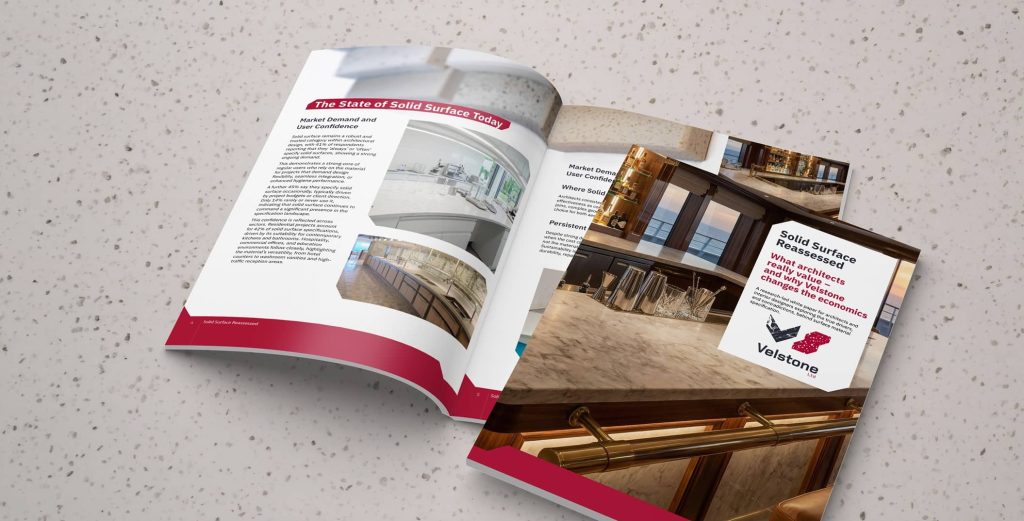
Faced with rising performance expectations, tighter budgets and heightened scrutiny around sustainability, architects are navigating an increasingly complex specification landscape. New research from Velstone reveals that the realities behind surface material choice are often more nuanced, and more contradictory, than they first appear.
Surface specification is rarely as straightforward as it seems. Aesthetic ambition, durability, budget constraints and sustainability targets all exert pressure, often pulling decisions in different directions.
To understand how these forces play out in practice, Velstone surveyed a significant cross-section of architects and interior designers in the UK, forming the basis of its new white paper, Solid Surface Reassessed. It explores the real drivers behind surface material selection, revealing the true drivers and contradictions that shape surface material specification today.
The findings confirm that solid surface remains a trusted and widely specified material. 41% per cent of respondents say they always or often specify solid surface, with a further 45% using it occasionally. Residential projects dominate, accounting for 42% of specifications, particularly in kitchens and bathrooms, while hospitality, commercial offices and education environments also feature strongly.
What emerges clearly is why architects continue to rely on solid surface. Longevity, repairability, design flexibility and colour choice consistently outweigh brand recognition or lead times. Seamless joints, non-porous performance and design ability make it a dependable solution where hygiene, durability and visual coherence matter.
Yet the research also exposes persistent misconceptions, particularly around cost. 34% per cent of respondents cite budget as a reason for avoiding solid surface, and 70% say cost is an important factor in surface selection. However, when architects move away from solid surface, 37% specify quartz – typically the most expensive option – while only 27% opt for laminate. This contradiction indicates that quartz is frequently associated with luxury, and that cost decisions are driven more by perceived value than by demonstrable performance benefits.
When compared to laminates, traditional solid surface specification has relied on layered processes: 13mm sheets, substrate backing, specialist fabrication, templating and multiple subcontractors. Each stage adds time, risk and cost, distorting perceptions of value.
The white paper also highlights a clear hierarchy in decision-making priorities. Nearly 90% of architects prioritise durability and repairability, making them the strongest drivers across the entire dataset. By contrast, only around half actively prioritise sustainability. Rather than indicating indifference, this gap reflects a practical understanding: materials that last longer and can be repaired rather than replaced inherently reduce waste, resource use and lifecycle cost. Longevity, whether labelled as such or not, is sustainability in action.
Velstone’s response to these challenges is a re-engineered approach to solid surface. Its 25mm self-supporting material removes the need for substrate, simplifies fabrication and enables more direct routes to site. The result is a specification model that aligns cost more closely with true material value, while delivering the long-term performance architects already demand and backed by ISO 14001 certification.
Solid Surface Reassessed concludes that the barriers to solid surface are not material-based, but process-based. As projects demand greater accountability around lifecycle value, programme certainty and environmental impact, outdated procurement models are no longer fit for purpose.
For architects and specifiers, the opportunity is clear; to challenge assumptions and specify based on performance rather than perception.